
Body Armor Levels: NIJ & Stab Guide
NIJ body armor levels IIA to IV, stab and spike standards, level 3 vs level 4 plates, and matching protection ratings to real threats for wholesale buyers.
Why Protection Levels Matter More Than the Vest
A customer walks in asking for a bulletproof vest. The real question is never "which vest" — it is "against what." A level IIA soft vest that stops a 9mm handgun round will not stop a rifle bullet. A level IV plate that stops armor-piercing rifle rounds is overkill, and overburdening, for an officer whose daily threat is a knife and a handgun.
Protection levels are the language buyers and suppliers use to make that match. This guide explains the rating systems — ballistic and stab — what each level actually stops, and how to spec armor correctly for military, police, corrections and security buyers.
The NIJ Ballistic Rating System
The National Institute of Justice (NIJ) standards are the reference point for body armor worldwide, and most national standards map onto them. The current standard, NIJ 0101.06, defines five ballistic levels for armor sold in the United States:
Level IIA — stops 9mm and .40 S&W at lower velocities. The lightest armor, designed for everyday concealment where threats are limited.
Level II — stops 9mm and .357 Magnum at higher velocities. The traditional standard for full-time police wear.
Level IIIA — stops .357 SIG and .44 Magnum, the highest handgun threat level. This is the most common choice for patrol soft armor because it stops virtually all handgun rounds while remaining concealable.
Level III — stops rifle rounds including 7.62mm and 5.56mm FMJ. Rifle protection requires hard plates; no soft vest stops rifle rounds.
Level IV — stops armor-piercing rifle rounds including .30-06 AP. The highest NIJ rating, found on the ceramic and composite plates used by military and tactical teams.
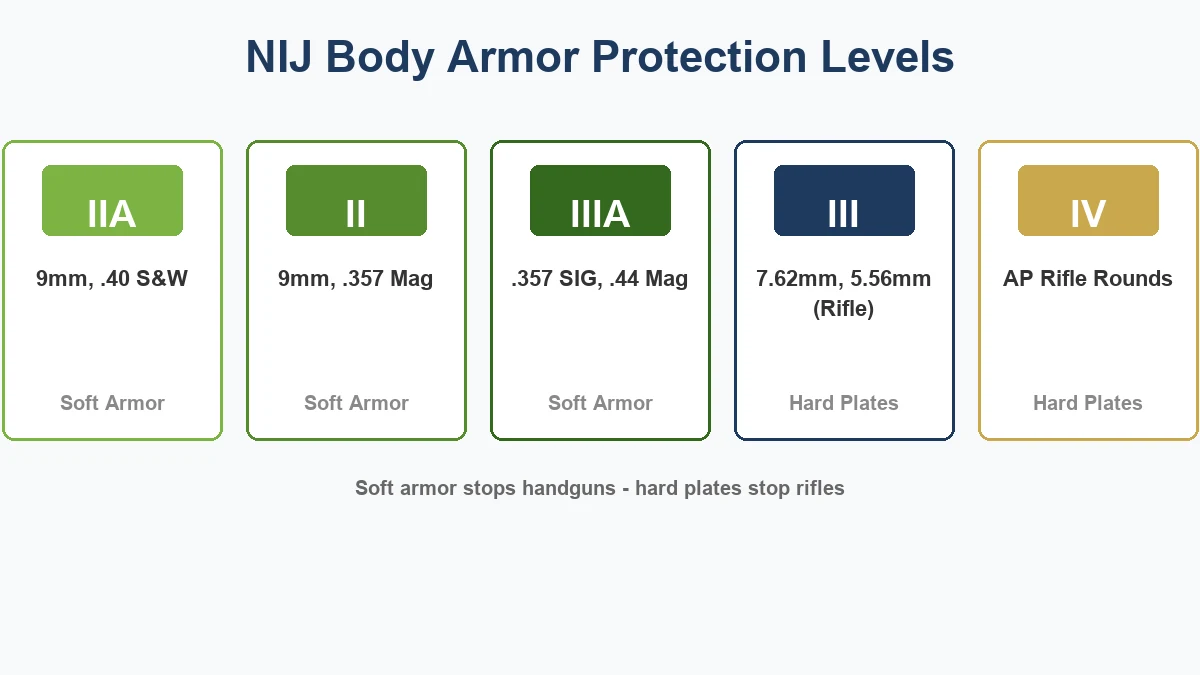
Our armor protection products cover the full hard plate range from level III to IV.
Soft Armor vs Hard Armor
The split is simple: soft armor stops handguns, hard armor stops rifles.
Soft armor (level IIA-IIIA) is layered aramid or UHMWPE fabric worn concealed or under a uniform. It is flexible, relatively light, and stops the handgun threats that make up the majority of officer-involved shootings.
Hard armor (level III-IV) is a rigid plate — ceramic, UHMWPE or steel — carried in a plate carrier or an outer carrier system. It is heavy, but it is the only armor that stops rifle fire.
Many modern systems combine both: a soft armor vest worn daily, with a plate carrier over it for high-risk entries. This is the "in conjunction with" approach — the soft vest acts as a trauma backer behind the plate.
Level 3 vs Level 4 Plates
The most common sourcing decision for tactical teams is level III versus level IV plates.
The honest advice: most buyers do not face armor-piercing rounds. Level III UHMWPE plates stop the rifle threats found in the vast majority of shootings at half the weight and lower cost of level IV. Level IV earns its weight when the threat assessment says AP rounds are real — military operations, certain high-risk security contracts, or agencies operating against well-armed adversaries.
If you are choosing between the two, start from the actual threat report, not from the highest number on the box.
Stab and Spike Protection: The Other Rating System
Bullets are not the only threat. Corrections officers, security guards and frontline police face edged weapons — knives, shivs and improvised blades — far more often than they face rifles. Stab protection is rated separately from ballistic protection because stopping a knife is a completely different mechanism than stopping a bullet.
A ballistic vest stops bullets by catching them in tension. A knife point, though, can push between the fibers of a woven aramid vest. Stab-resistant vests solve this with tighter weaves, coated fabrics or chainmail-style metal layers that resist puncture.
Two standards matter:
NIJ 0115.00 — the stab standard, rating armor against edged blades (knives) and spike threats at different energy levels.
UK Home Office standards (KR1-KR2) — widely used internationally for knife-resistant armor, with KR1 being the lower energy and KR2 the higher.
What buyers should know: a vest can be ballistic-rated, stab-rated, or both. Corrections departments typically buy stab-resistant or combination vests because their threat environment is edged weapons. Police on the street face both, so combination armor — ballistic IIIA plus stab resistance — is increasingly standard. See our riot and corrections gear range for stab-rated options used in custody environments.
Common Level Confusions
"Level 10 body armor" — there is no NIJ level 10. This phrase usually comes from video games or misunderstanding of the Roman numeral X in older marketing. Real ratings stop at IV. If a supplier quotes "level 10" or "class 6" armor as an official rating, treat the claim as a red flag and ask for the actual NIJ certification document.
"Class 3" vs "level III" — same thing in different words. The NIJ standard uses Roman numerals (III, IIIA, IV); older European and commercial labels sometimes say "class 3." Always confirm against the NIJ document, not the label.
"Level 7 body armor" — another fiction. No recognized body armor standard has a level 7. The confusion comes from Chinese commercial armor that labels products with numbers that sound impressive — a marketing practice serious buyers verify against real certification before ordering.
"Level IIIA+ / III+" — not official NIJ levels, but common commercial labels for armor tested beyond the standard level (like IIIA stopping a specific rifle round in testing). Fine to buy if the supplier provides the actual test report, but the plus ratings are not interchangeable between manufacturers.
How to Verify Armor Certification
When buying armor for a department, certification documents are not optional:
1. Ask for the NIJ certification letter or the compliance test report for the exact model — not the material, not the brand, the specific vest or plate model.
2. Check the NIJ Compliant Products List (CPL) if selling into the US market — armor on the CPL has passed NIJ testing.
3. Request the test lab name and confirm the report covers the level you are buying.
4. Beware of "armor grade" and "stab resistant" claims without a standard reference — if it does not cite a standard, it has not been tested to one.
Our factory provides certification documentation with wholesale orders, and we walk buyers through the compliance requirements for their market. Read more in our NIJ body armor standards guide.
FAQ
What level body armor do police officers wear?
Most patrol officers wear level IIIA soft armor daily. Tactical teams add level III or IV plates for high-risk calls.
Can a level IIIA vest stop a rifle bullet?
No. IIIA stops high-velocity handgun rounds. Rifle rounds need level III or IV hard plates.
What is the difference between stab proof and bulletproof?
Stab-proof armor resists edged weapons and spikes; bulletproof armor resists bullets. They use different materials and are tested to different standards. Some armor does both.
Do corrections officers need stab vests?
Yes — corrections environments are dominated by edged weapon threats, making stab-resistant or combination armor the standard for custody staff.
What does level IV body armor stop?
Level IV stops armor-piercing rifle rounds including .30-06 AP, the highest rating in the NIJ system.
Final Word
Protection levels exist to take guesswork out of armor buying. Match the level to the documented threat — handgun for patrol, rifle for tactical entry, stab for corrections — and verify every claim against the actual certification. Armor is the one product category where a marketing label mistake can cost a life, so serious buyers check the paperwork before they check the price.
Our factory supplies ballistic armor systems and riot control protection with certified materials and full documentation. Tell us the threat environment, and we will spec the right level.
Published: 2026-09-02 | Category: Materials & Standards
Related Articles
Mag Pouches Guide: Types, Mounting, MOLLE
Mag pouches guide: rifle, AK, pistol, triple and taco-style mag pouches, MOLLE and duty belt mounting, materials and wholesale ordering for dealers.
MOLLE Pouches Guide: Types and Mounting
MOLLE pouches guide: GP, admin, phone, flashlight and utility pouch types, mounting compatibility with carriers and packs, materials and wholesale sourcing.