
Army Dress Uniform Guide: ASU and Classes
Army dress uniform guide: ASU meaning, Class A B C differences, pinks and greens service wear, dress blues formality and uniform OEM sourcing terms.
Army Dress Uniforms and the Class System
The army uniform family runs from physical training gear to full formal dress, and most buyers meet it through the shorthand labels Class A, Class B and Class C. In everyday terms, Class A means the service dress combination with a coat, Class B means the service shirt worn without the coat, and Class C means the camouflage field uniform used for training and duty. Above that daily rotation sit the dress uniforms worn for parades, reviews and formal occasions. This guide explains what each class means, what the ASU name stands for, what the formal dress tier includes, how the appearance regulations frame all of it, and how organizations source service and ceremonial clothing through OEM production.
Think of the uniform family as a formality scale. At one end sits the physical training clothing covered in the army PT uniform guide; in the middle stands the field uniform, with the OCP uniform guide covering the camouflage standard worn for most duty; at the far end sits the service and dress clothing described on this page. The distinctions matter for buyers because each tier is specified, produced and priced differently: field clothing is made in volume to standard sizes, while service and dress clothing is tailored, trimmed and fitted to a corps or a ceremony. One note before the details: this article is an unofficial overview in general terms. Uniform names, colors and wear rules shift with each official revision, so always confirm requirements against the current published version before planning an order.
Army Service Uniform ASU
ASU stands for Army Service Uniform, the service dress worn for garrison duty, office work and formal functions below full-dress level. A complete set runs to a tailored coat with matching trousers or skirt, a service shirt with tie or neck tab, a belt, headgear and polished dress shoes, with ribbons, name tapes and rank insignia — officer and enlisted patterns differ — added under regulation rules. Where the combat uniform is built loose for movement, the service uniform is built to sit: the coat is shaped at the waist, sleeves end at the wristbone, and the trouser crease is part of the uniform.
The color story behind the ASU explains most of the search traffic on this topic. The Army has moved between blue-toned and green-toned service uniforms over the decades, and the green-toned uniform in current fielding is popularly known as pinks and greens, a nickname carried from the traditional pairing of a green coat with lighter trousers. Different eras, branches and revisions describe different garments under the same initials, which is exactly why a buyer should treat any published description as background and verify the current official nomenclature before writing a specification. The shirt inside the set belongs to the wider uniform shirt family — dress, polo and duty shirts — covered in the tactical shirts guide.
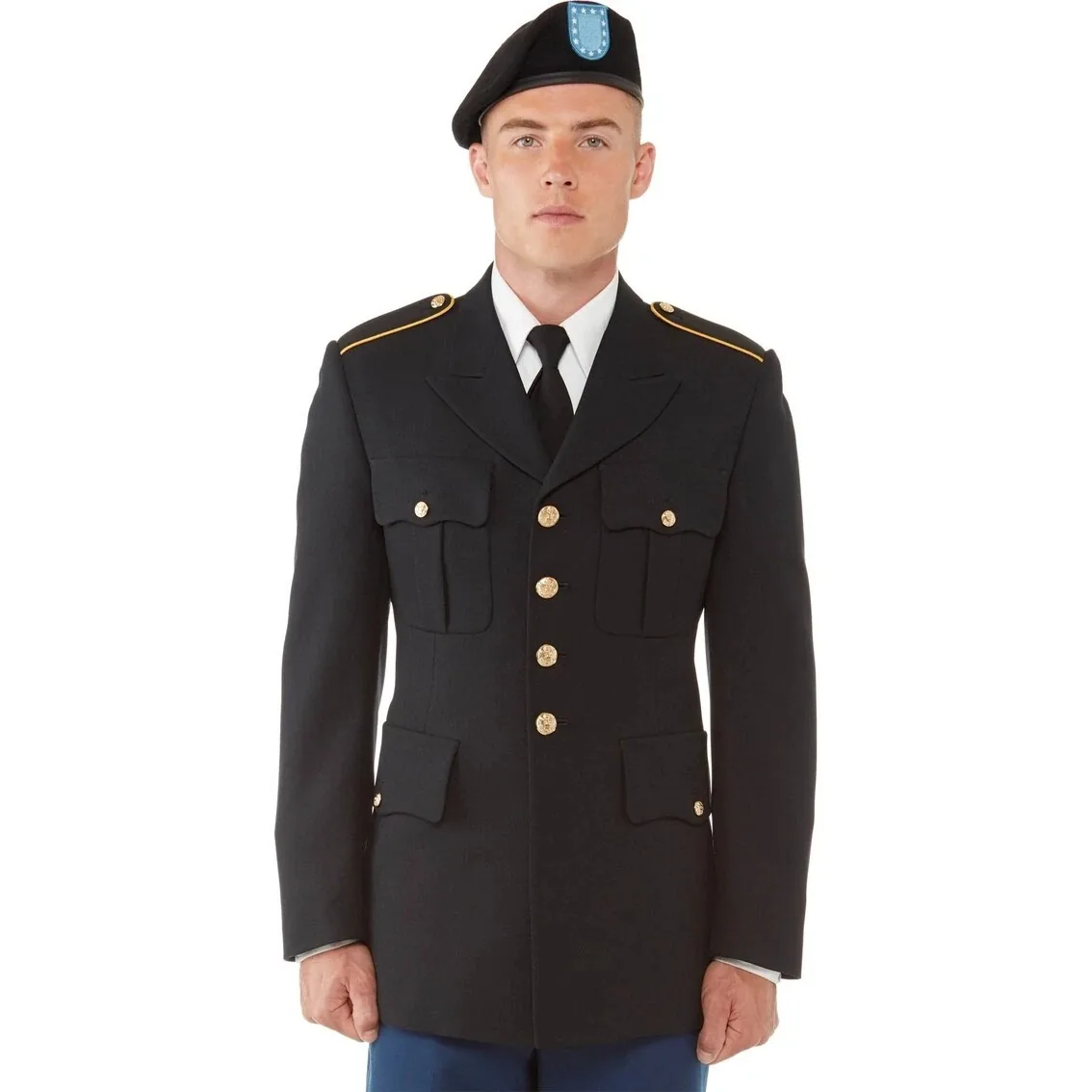
Dress Uniforms
The dress tier sits above the service uniform and covers the clothing worn when the event itself is the point: parades, change of command and retirement ceremonies, official receptions and formal dinners. The classic army dress uniform is the dark blue dress uniform, with a white dress variant for summer ceremonies and warm-climate duty, and mess dress for evening events. What separates dress from service wear is not the cut alone — it is the accoutrement: braid and piping, medals worn in place of ribbons, formal headgear, and in ceremonial units white gloves, sashes and other regalia that must align perfectly across a formation.
Because dress uniforms are event clothing, demand concentrates in organizations that perform ceremony on a schedule: ceremonial companies and honor guards, academy cadets, drill teams, marching bands, and the uniformed security details attached to embassies, government buildings and state events. These units buy in matched sets — every coat, trouser, cap and glove cut to the same standard so a rank of fifty looks like one body — and they reorder against the same pattern as members cycle through. That combination of exact fit, matched trim and repeated reorder is the natural profile of made-to-order uniform production rather than catalog stock.
From our factory floor: Dress uniforms demand the most careful work on our tailoring lines. We press each panel before assembly, set the lining without puckering, and finish embroidery so the reverse side stays clean against the skin. Every piece passes our five point inspection covering material, cutting precision, stitch tension, function and appearance. Request a finished sample before full production.
Class A vs Class B vs Class C
Class A, Class B and Class C are informal shorthand for ranking how formal a uniform appearance is. The definitions below are the everyday meanings a buyer will meet in catalogs, procurement documents and conversation; they are not a substitute for the current official regulation, which is the only authority on what may actually be worn.
In the current Army context, Class C maps to the OCP field uniform family, available as ready-made production in the combat uniform catalog, with garments such as the OCP field outfit and the ACU training suit covering the field and training ends of the scale. Class A and Class B map onto the service uniform discussed earlier, while the dress tier covered in the previous section sits above them. The class letters are therefore best read as a ladder of formality rather than a fixed wardrobe list, because the labels have shifted between eras, services and branches.
Regulations
The single regulation behind almost every question about army uniforms is AR 670-1, which governs the wear and appearance of uniforms and insignia: which uniform fits which occasion, where name tapes, rank and unit insignia are placed, how accessories and headgear are worn, and how the whole system is maintained and presented. It is revised on a rolling basis, and published summaries age quickly, so the working rule for anyone specifying uniforms is to pull the current version and read the sections that apply to the specific garment and occasion. This page deliberately describes the system in general terms only.
The regulation also reaches into footwear, which is why dress shoes, service boots and combat boots are treated as separate items with separate rules; the AR 670-1 boots guide walks through that footwear logic in detail. Organizations that mirror military standards — academies, cadet corps, ceremonial units, government security details — normally import the same policy shape into their own appearance manuals, so a buyer in those sectors is effectively specifying against AR 670-1 even when the client is not a military branch. Ask for the current edition of the governing policy in writing before the specification stage begins.
Sourcing Dress Uniforms
Service and dress uniforms are specification products, not shelf products. Field uniforms are bought by the thousand against standard military sizes; dress uniforms are bought by the company, the ceremony and the corps, against a fixed pattern, a fixed trim package and a size run built from real bodies. The buyers are the organizations that must look identical in public: military academies and cadet programs, honor guards and drill teams, ceremonial police units, marching bands, embassy and consular security details, veteran service organizations and private military schools. Their orders differ from combat uniform buying in five concrete ways: tailored fit rather than loose field sizing, graded size runs rather than a small set of sizes, trim packages of braid, piping, buttons and lanyards, insignia and name tape mounting, and presentation standards such as pressing and issue packaging.
The correct production route for this profile is OEM: the client supplies the pattern base or an existing garment to copy, the factory matches fabric and trims to the required shade standard, and a graded sample set is fitted on representative body types before any bulk run. Accessories such as ties, belts, caps and gloves should come from the same production so their colors match the garments under ceremony lights. For agencies whose daily duty need is field-side rather than formal, the ready-made security guard combat uniform covers the workday, while service and ceremonial garments go through custom production. Our uniform OEM line builds service, dress and ceremonial garments to customer patterns and specifications, covering coat and trouser tailoring, trim application, insignia mounting and full accessory matching — see the uniform OEM manufacturing program for the full production scope.
Wholesale Sourcing Checklist
A dress uniform program succeeds or fails at the specification stage, so lock the appearance standard before requesting a single sample. Every item below is confirmed on the graded sample, and only then does the bulk order proceed.
Dress uniform order terms — trial orders from 50, MOQ 100 pieces, samples 5-7 days, production 20-30 days; the pattern, trims and insignia mounting are confirmed on the sample before bulk.
FAQ
What are the classes of army uniforms?
Class A, Class B and Class C are informal labels that rank formality: Class A wears the service coat with matching trousers, Class B wears the service shirt without the coat, and Class C wears the camouflage field uniform. Formal dress clothing sits above Class A and the physical training uniform sits below Class C, and exact meanings have shifted between eras and services, so confirm against the current regulation.
What is the ASU uniform?
ASU stands for Army Service Uniform, the service dress worn for garrison duty and formal functions below full-dress level, classically a tailored coat with trousers or skirt, a shirt with tie or neck tab, a belt and polished shoes. The green-toned service uniform is popularly called pinks and greens, and current details should always be verified against the latest official publication.
What is a class B uniform?
A Class B uniform is the service shirt worn without the coat: the same shirt and trousers as Class A but with the coat removed, making it the standard garrison and office wear, with long or short sleeves depending on the season. Because the labels shift between services and eras, buyers should match the term to the specific regulation in force.
What is the army green service uniform?
The army green uniform, often called the pinks and greens style after its colors, is the current Army Service Uniform for garrison wear, while the older army blues uniform serves formal events and the army graduation uniform is the dress version worn at training completion. Army greens and the agsu uniform refer to the same green service system. Army ranger uniform and army reserve uniform follow the same class rules with unit-specific insignia.
What is the difference between ASU and army dress blues?
The ASU is the green-toned Army Service Uniform worn for routine garrison and official duty, while army dress blues are the more formal blue uniform reserved for ceremonies, balls, and special occasions. Dress blues carry more embellishment such as braid and medals and are rarely required for everyday duty. Departments and outfitters stock both because issue requirements vary by event and unit.
How much does an army dress uniform cost?
A complete army dress uniform typically costs several hundred dollars per set depending on tailoring, insignia, and fabric quality, with dress blues running higher than the green service uniform because of added ornamentation. Procurement pricing improves with quantity: bulk orders through a manufacturer remove retail markup and keep sizing consistent across a unit.
Can I order army dress uniforms in bulk for a unit or brand?
Yes. Army dress uniforms can be manufactured in bulk to your specification with correct class cuts, service colors, and insignia placement under an OEM program. Share your size run and event requirements, and we will produce a sample set for approval before full production, with samples in 5-7 days and bulk delivery in 20-30 days.
Final Word
A dress uniform order is an exercise in specification discipline: one appearance standard, one pattern, one trim package and a size run built from real people. Organizations that respect that sequence reorder the same uniform for years without drama, while those that skip the sample stage relive the fit problems at every ceremony. Our factory produces ready-made combat and field uniforms for the duty side of the spectrum and builds service, dress and ceremonial garments to customer patterns through the uniform OEM line. Send the governing policy excerpt, the size data from your roster and the trim list, and we will quote the program on sample-first terms.elive the fit problems at every ceremony. Our factory produces ready-made combat and field uniforms for the duty side of the spectrum and builds service, dress and ceremonial garments to customer patterns through the uniform OEM line. Send the governing policy excerpt, the size data from your roster and the trim list, and we will quote the program on sample-first terms.
Published: 2026-09-04 | Category: Buying Guide | Updated: 2026-09-05
Related Articles
Military Bulletproof Vest Sizing Guide
Bulletproof vest sizing for Military and police units: how to measure chest, torso and shoulders, read a sizing chart, check fit and order a size mix in bulk.
SWAT Helmet Guide for Tactical Units
Bulletproof and ballistic SWAT helmet guide: threat levels, cut coverage, NVG and headset accessories, certifications and bulk ordering terms.